




On December the 10th 2025, the European GNSS Dual-Frequency/Multi-Constellation for GBAS Based Operations (EDGAR) project team submitted their final deliverables. This milestone highlights the significant achievements made over EDGAR’s two-year duration and paves the way to complete DFMC GBAS development.
The EDGAR project, co-funded by EUSPA through the EU Horizon Europe programme, has concluded after two years of intense work, delivering essential contributions towards the development of a robust GBAS solution enabling CAT II/III operations at any airport.
EDGAR project, led by ENAIRE and carried out by an European consortium comprising industry partners (Indra Navia, Boeing Aerospace and PildoLabs), research institutions (the German Aerospace Center DLR, the Norwegian research organization SINTEF and the Zurich University of Applied Sciences ZHAW) and air navigation service providers (DFS, ENAV, and ENAIRE), has worked to propose an enhanced GBAS system thanks to the use of Galileo satellites and dual-frequency signals.
MAIN OUTCOMES OF EDGAR PROJECT
EDGAR thoroughly analysed and leveraged the contribution of dual-frequency Galileo and GPS signals into future GBAS operations, measuring the improvement observed in positioning accuracy, the integrity of the navigation solution and system resilience.
The research focused on the following areas, delivering valuable results that were shared with the GBAS community and used as a foundation for the development of DFMC GBAS:
-
First analysis and testing of DFMC GBAS nominal mode of operation (the so-called GAST E) as well as different fallback modes when the primary GBAS service is degraded or unavailable.
-
The methodology to model scintillation associated with plasma bubble structures has been developed. The ultimate objective of this model is to predict the temporal evolution of plasma bubbles and the resulting scintillation effects, with the aim of enabling near-term predictions of DFMC GBAS availability at specific airports.
-
Investigation of the potential relaxation of requirements enabled by processing ground measurements at the airborne side, with the aim of reducing constraints (e.g. siting, monitors needed) on fallback modes.
-
Improvement of integrity monitors:
-
Threshold derivation for the Dual Solution Ionospheric Gradient Monitoring Algorithm (DSIGMA) for GAST D1 and GAST D2 fallback modes based on real measurements from flight campaigns provided by ENRI. First analysis of the monitor for the L5/E5a-only mode as well as with the new VDB capacity constraints. An assessment of the monitor was done using measurements from flight campaigns performed by ENRI under strong scintillation conditions.
-
Threshold derivation for the ground Code Carrier Divergence (CCD) for GAST D1 and GAST D2 fallback modes based on real measurements from DFMC Multipath Limiting Antennas (MLAs) installed in Tenerife Norte. First analysis of the monitor for the L5/E5a-only mode. An assessment of the monitor was done using measurements from one MLA installed at Tenerife Norte recorded under strong scintillation conditions.
-
Threshold derivation for the airborne Code Carrier Divergence (CCD) for GAST D1 and GAST D2 fallback modes based on real measurements from flight campaigns carried out during the Horizon 2020 DUFMAN project. First analysis of the monitor for the L5/E5a-only mode. An assessment of the monitor was done using measurements from flight campaigns performed by ENRI under strong scintillation conditions.
-
-
The use of GPS and Galileo constellations to enhance the integrity and availability performance of GAST-E by increasing the diversity of satellite geometries, particularly under disturbed ionospheric conditions.
-
Characterization of ground DFMC MLA errors in DLR’s anechoic chamber as well as analysis of the impact of the calibration of antenna errors on DFMC GBAS performance.
-
Analysis of MLA multipath susceptibility in an exemplary scenario by the use of MLA digital twins.
-
Extension of existing aircraft multipath error models for use in DFMC GBAS operations.
-
Verification of Ground Accuracy Designator (GAD) models for the DFMC GBAS ground station considering the use of Galileo signals, and providing input to the ICAO Standards and Recommended Practices (SARPs).
-
Contributing to the definition of Message Type 23 within the ICAO DFMC GBAS SARPs Drafting Group. This message is used to broadcast measurements from the GBAS ground subsystem to the airborne subsystem.
-
Evaluation of augmented geometry screening to support CAT II for GAST C users based on GAST D using EGNSS to take into account the measured ionospheric activity and reduce conservatism.
-
TEC map prediction and its use in GBAS.
-
Assessment of Radio Frequency Interference (RFI) impact on GBAS reference receivers.
-
Validation of scintillation indices based on difference receiver types to assess the dependency of these indices with receiver parameters or characteristics with the ultimate goal of using them for monitoring.
EDGAR DISSEMINATION ACTIVITIES
Throughout the project, EDGAR contributed to major scientific and standardisation fora on navigation and GBAS development:
-
A myriad of papers and presentations were submitted in conferences and symposiums (ION GNSS+ 2024 & 2025, ION ITM 2025, Beacon Satellite Symposium 2025, ICL GNSS 2025, IEEE/ION PLANS 2025), as for example:
-
S. P. Hehenberger, M. Caamano, B. Gabler and S. Caizzone, "Group Delay Characterization of Multipath Limiting Ground Station Antennas for Enhanced GBAS Performance," 2025 IEEE/ION Position, Location and Navigation Symposium (PLANS), Salt Lake City, UT, USA, 2025, pp. 188-192, doi: 10.1109/PLANS61210.2025.11028243
-
McGraw, Gary A., Caamano, Maria, "Multi-Process Stochastic Error Models for DFMC GBAS Carrier Smoothed Code Processing and Preliminary Airborne Results," Proceedings of the 38th International Technical Meeting of the Satellite Division of The Institute of Navigation (ION GNSS+ 2025), Baltimore, Maryland, September 2025, pp. 158-177. https://doi.org/10.33012/2025.20266
-
Felux, Michael, Nietlispach, Michael, "From Ground to Air: The Paradigm Shift in GBAS Monitoring and Its Benefits," Proceedings of the 2025 International Technical Meeting of The Institute of Navigation, Long Beach, California, January 2025, pp. 305-317. https://doi.org/10.33012/2025.19962
-
Tuffaha M., Bodero A. WP/9 Multiple Hypothesis Protection Level Verification for the Proposed MT23 Reduction Scheme, 2025, Joint Working Groups JWGs/15, Montreal, ICAO
-
-
Multiple papers and presentations in aviation standardization working groups (the ICAO NSP GWG and IGM ad-hoc group, the RTCA S-159 WG4, and the EUROCAE WG28),
-
Several presentations at the International GBAS Working Group (IGWG) for worldwide GBAS community coordination, and
-
It is foreseen a publication at the scientific journal NAVIGATION: Journal of the ION (ISSN 2161-4296).
These publications allowed EDGAR consortium members to share project research, results and proposals, playing an active role in the ongoing development of the DFMC GBAS architecture and requirements definition.
A European boost to future aeronautical navigation
EDGAR results provide a solid technical basis to support ongoing international work to pave the way of GBAS to dual-frequency and multi-constellation capabilities. The project consolidates Europe's role in technological leadership in satellite navigation applied to aviation and lays the foundation for future standardization development and activities.
This progress was further strengthened by the project’s strong international cooperation, fostered through the active involvement of advisory board members from institutions such as ENRI, KAIST, Stanford University, EUROCONTROL, and Collins Aerospace, with collaboration consolidated not only through technical discussions and deliverable reviews but also through joint scientific publications developed within the project framework.
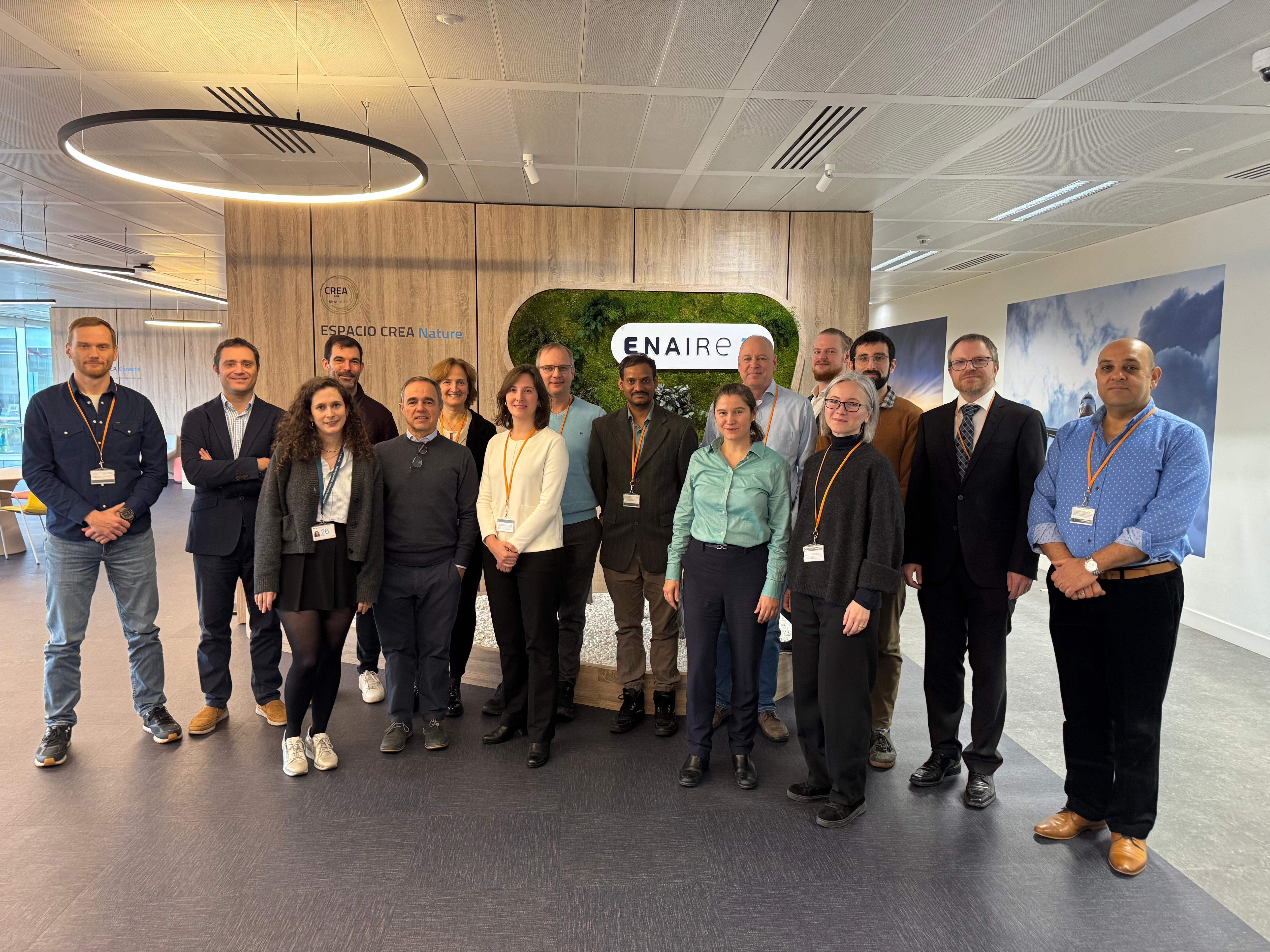
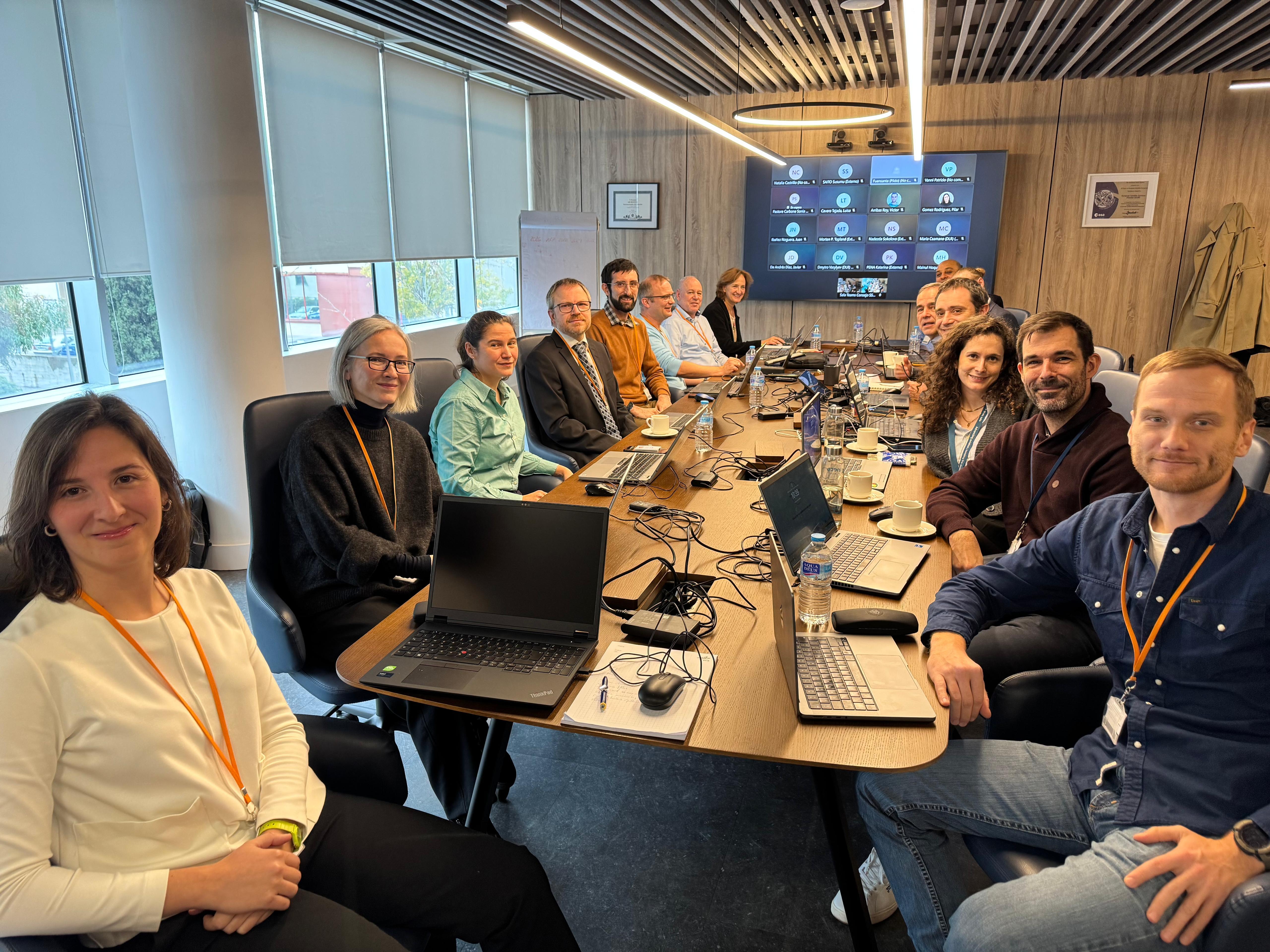
EDGAR members during last meeting at ENAIRE Headquarters