

Aeronautical navigation has changed substantially as reliance on Global Navigation Satellite Systems (GNSS) has grown. GNSS is a core element of Performance‑Based Navigation (PBN) and allows airspace users to demonstrate that their navigation systems meet the required performance parameters (accuracy, integrity, continuity, and availability) for each phase of flight.
However, GNSS alone does not always deliver the performance needed for safety‑critical operations such as precision approaches and automatic landings. To use GNSS as the primary navigation source for those operations, augmentation strategies are required. The main augmentation architectures are Aircraft‑Based Augmentation Systems (ABAS), Space‑Based Augmentation Systems (SBAS), and Ground‑Based Augmentation Systems (GBAS).
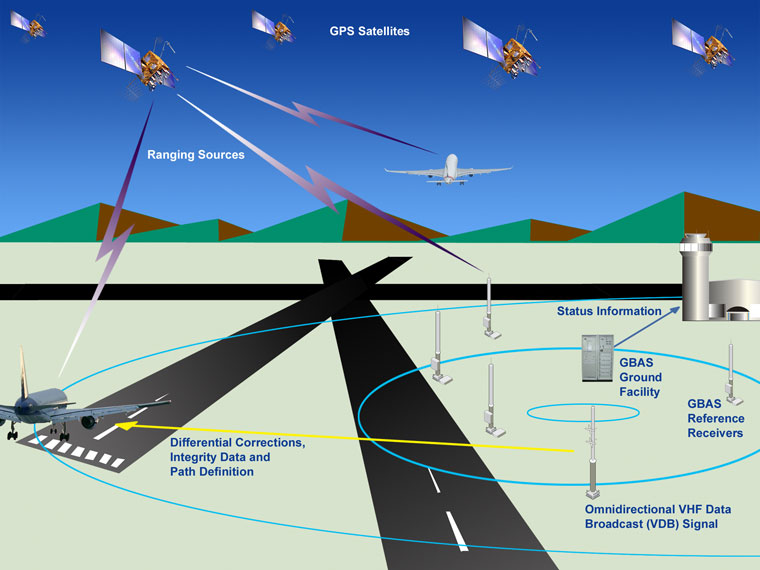
GBAS is an airport‑based, local augmentation system that provides precision approach guidance. It enhances GNSS performance by transmitting differential corrections and integrity information to aircraft. Differential corrections remove part of spatially correlated errors between the ground station and the aircraft, while integrity data let the airborne system estimate safe bounds on position errors.
The GBAS architecture comprises a ground subsystem, including the Ground Facility, Reference Receivers and the VHF Data Broadcast (VDB), and an aircraft subsystem. The ground subsystem can support multiple aircraft within its service volume (nominally about 23 NM). It supplies approach‑path data, differential corrections, and integrity information to aircraft in the service area. For each satellite tracked by the ground system, these data are broadcast via the VHF link.
For more detail and a deeper understanding of GBAS, visit the following sections:
- The problem that GBAS solves
- Benefits of GBAS
- GBAS Principles
- GBAS Architecture
- GBAS Messages
- Essential GBAS Pre-requisites
- GBAS Levels of Service
- Differences to ILS